(JJ Hurley)
A tradition of pantomime has existed in the fabric of Kinsale’s Christmas calendar, but when did the spectacle make its opening debut?
A trawl of the newspapers reveals a proud tradition of variety performances as far back as the late 19th century, but the emergence of pantomime appears in the late 1930s.
The first reference to the much-loved stage show belonged not to a locally arranged effort, but to the members of the Fr Mathew Players, Cork.
Treading the boards at the beginning of February 1938, their production of Cinderella was well received by large attendances at the Municipal Hall.
Incidentally, it was Kinsale GAA Club that brought the production to the seaside venue, with the reporter in the Southern Star remarking, ‘The club considered themselves very privileged to receive the patronage of this talented company.’
It was not long before Kinsale began to get its act together, as Johnny Gimblett emerged as director of the efforts of the students at Kinsale Vocational School (now the College of Further Education).
An article in the Southern Star reported that pupils were busy rehearsing for an upcoming production of Cinderella, set to take to the stage on December 27th, 1947.
Unfortunately, the show was axed in 1948. The Southern Star reported a meeting of Kinsale Vocational Students’ Union, with Mr J. Cotter, chairman, presiding, where it was decided, ‘in view of the adverse financial position consequent on a year’s heavy expenditure’, not to undertake the usual pantomime but instead to promote a concert with local talent.
However, in the ‘Kinsale Pars’ at the end of the tumultuous decade of the 1940s, the Southern Star reported a large audience at the vocational school for the opening night of the town’s pantomime in 1949.
Presented by the Students’ Union at the Bandon Road venue, the production on offer was a local interpretation of Babes in the Woods.
In the Southern Star in 1995, we got a picture into those productions at the time, as Leo McMahon interviewed Christy Fitzgerald.
A member of the Students’ Union at the Technical School, Christy recalled three of the productions the students had staged. Included in the line-up were Aladdin, Sleeping Beauty and Babes in the Woods.
In the interview, Christy said the production was made up of students and past pupils, with Johnny Gimblett putting the actors through their paces, assisted by Paddy Bogue and Marie O’Donovan.
Indeed, Marie continued for many years to provide the music at the pantomimes right up to the late ’60s.
For the record, the entrance fee into the production was one shilling.
Unfortunately, there are no records of who starred in that production, but the reporter did record that it was an excellent performance.
The 1950s were a decade best forgotten for many reasons, as the country became an economic wasteland and many young people left to find work abroad. This was reflected, possibly, in the absence of pantomime in Kinsale. Other towns and villages continued to host the annual slapstick humour, but Kinsale seemed to lack the spirit to put on a show.
It was not until the late ’60s that the Southern Star reported that productions were back.
Wait for it — the return was dramatic: St Patrick’s Night, 1968.
Incidentally, the paper reported that it was fourteen years since the last local pantomime had taken place.
The response, according to its pages, was extremely positive. The Roving Scribe, in their weekly column A Country Diary, suggested that ‘people turned out in their droves’ to see the performance.
Attributing the success of the show to Johnny Gimblett, the Roving Scribe wrote, ‘Johnny has wielded a blend of young and old of the Kinsale Dramatic Society into a very professional unit.’
‘Played out in three performances in February, the demand was so great that, even though it may not be seasonally correct now, the warmth and charm of the Christmas season will continue to permeate again next Sunday and Monday night.’
Featuring on the stage of the Municipal Hall were John Ahern, taking the time-honoured part of the Baron; Finbarr Hurley as the Dame; Maurice Murphy and Teddy Calnan as the Ugly Sisters; Mary Ahern as the Fairy Godmother; Mary Goggin as Cinderella; and Florence O’Connell as Dandini.
Other youthful members of the cast included Noreen Collins, Donie Searls, Denis Lynch and Joe Gimblett, while Dermot Ryan, Liam O’Riordan, Michael Foran and Michael Brennan looked after the lighting.
The significant lapse in hosting a local performance may be explained by the requirement to raise £270 to pay for lighting and other equipment — a princely sum at the time — helped by a contribution of £50 from Kinsale Community Centre, presented by its treasurer, Eileen Murphy.
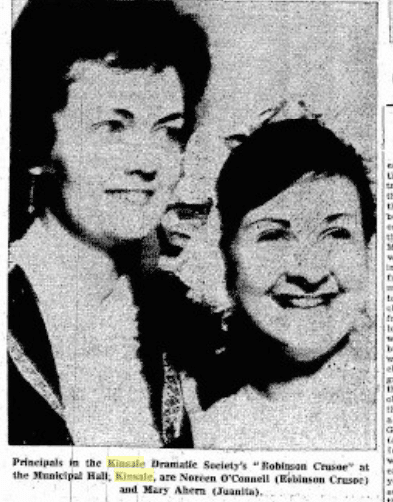
In 1969, the town’s performers were back on stage, this time with a production reflecting Kinsale’s maritime tradition: Robinson Crusoe.
Once again, the Southern Star’s Roving Scribe paid the show a huge compliment in A Country Diary.
‘Everyone agreed that, without a doubt, it was the most professional-like staging of a pantomime by a group who, needless to mention, are not professional,’ the reporter remarked.
‘It can be fairly said that, in contrast to RTÉ’s rather heavy-handed effort of a pantomime on Christmas night, Robinson Crusoe went with a great swing from the start to the national anthem.’
No doubt this was helped by the legendary town Dame, Finbarr Hurley, aided by Noreen O’Connell and Mary Ahern.
Also featuring was Frank Hurley, aided by Jerry Hurley, Dan Hurley, Michael Ahern, Denis O’Leary and Denis Gimblett in his cannibal gang, with the old reliables Maurice Murphy and Teddy Calnan also on stage.
In 1971, Babes in the Woods provided the theme for that year’s pantomime, produced by 76-year-old Johnny Gimblett. The papers reported that he had first directed a play in 1921.
Also appearing was Johnny’s son Joe, and Joe’s daughters, Gemma, aged six, and Helen, aged twelve.
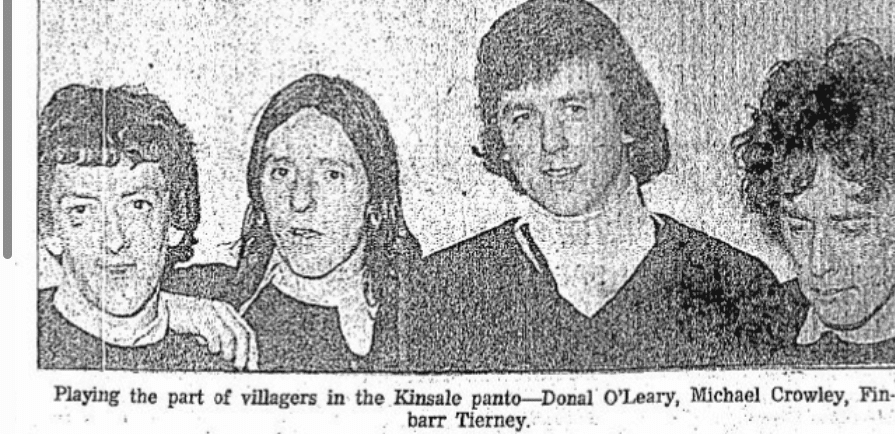
The outstanding performance award went to Finbarr Hurley for his faultless portrayal of the Dame. As the Southern Star reported, ‘The star of the show as always is Finbarr Hurley, who has played the part of the Dame in all the recent performances, giving another polished performance.’
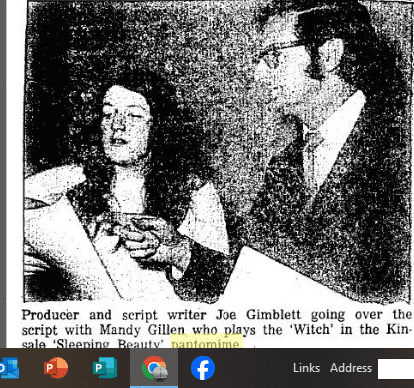
By 1973, Joe Gimblett had taken the script and production mantle from his father, as another name synonymous with Kinsale pantomime entered the fray: Eddie Hogan.
On stage that year were Ann Crowley as the Princess and Noreen O’Connell as the Prince, along with John O’Connell, Mandy Gillan and, of course, Frank Hurley.
The ’70s proved to be a golden age for pantomime. Reviews spoke of packed-out audiences and multiple nights of performances, but as many of those involved went on to raise young families, the shows gradually faded.
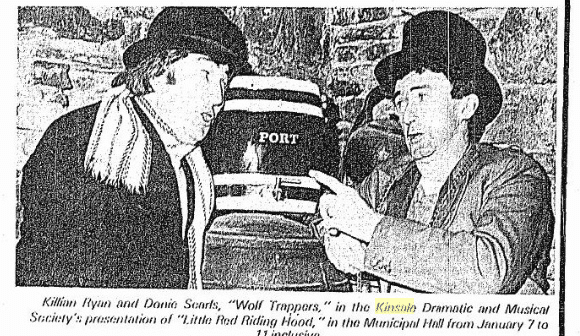
Pantomime made a welcome return in 1985 with an old favourite. Regulars including Eddie Hogan, Donie Searls, Frank Hurley and Finbarr Hurley were joined by another man who would become closely associated with the productions: Killian Ryan.
That year also saw the arrival of several key contributors behind the scenes. Cal Duggan entered the fray as make-up artist; Vincent McCarthy oversaw the music; Colette Acton put the dancers through their paces; and Mary Hurley took charge of costumes.
A number of young people from the town, including Geraldine O’Donovan, Sinéad Edwards, Áine Ryan, Shirley Hyland, Denis Keohane and Denis Farley, cut their theatrical teeth that year.
Tragically, the real star of the show, Adrienne Murray, who played the Prince, lost her life only a few weeks later.
Not only was this a devastating blow for her family, it cast a shadow over the entire town. Her performance on that stage, however, will long be remembered despite the terrible circumstances of her loss.
As the decade drew to a close, Cal Duggan assumed the mantle of producer, while the cast was joined by Nicky Searls and Mary Curran.
Mary became a firm favourite — a natural actor with a knack for delivering her lines right on cue.
By this time, the pantomime had moved from the Municipal Hall to the hall at the Convent of Mercy Secondary School, marking the beginning of a new chapter in Kinsale’s enduring love affair with pantomime.
In January 1987, the production returned to its most favoured home at the Municipal Hall.
The offering for the people that year was Little Red Riding Hood, with the late Mary Curran chosen to play the role.
Reporting on the production leading up to its first night’s airing, Leo McMahon wrote in the Southern Star, ‘With so many subplots as well, the panto is full of hilarious scenes of chaos as well as plenty of romance, and there is a great finale.’
Behind the scenes that year, Cal Duggan again pulled the strings, while other important roles included the make-up artists Rose Frawley, Mark Goggin, Ellen O’Connell and Margo Searls, and costume responsibilities fell to Margaret Thuiller, Rita Maher, Jean Boyle, Irene Jenkins and Sally Fitzgerald.
For many years, the show’s responsibility fell on the shoulders of Kinsale Dramatic Society, later to become the Rampart Players, but in 1987 the committee was made up of Killian Ryan, Nora Madden, Sandra Sheehan, Tomas O’Brien, Cal Duggan and Eddie Hogan.
By the early ’90s, the productions were coming hot and heavy, as Jack and the Beanstalk was the preferred choice for 1990, with Flor Dullea reporting in the Southern Star a 60-strong cast.
The following year, in 1991, the cast — which now included not one but two Dames, Finbarr Hurley and Killian Ryan — was joined by two of Kinsale’s newest funny men of their generation, Davie Peare and Sean O’Callaghan.
Of course, the old favourites Frank Hurley and Mary Curran were still strutting their stuff, as was John Thuiller.
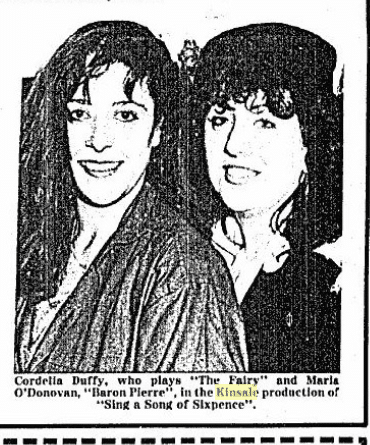
An unusual title, Sing a Song of Sixpence, followed that year. The story centred around a rich King, thanks to a magic crown. For this reason, he was being courted by Baroness Bridie of Antibes, as she had lost her money, but the wicked witch steals the crown and the story developed from there.
By 1996, a lack of a venue meant that the local pantomime had become homeless, as the Municipal Hall was unavailable and the secondary school hall at the Mercy was no longer in use.
The issue was raised by Cllr Tomas O’Brien, another regular with the local shows. In a report in the Southern Star, Cllr O’Brien remarked, ‘It is very sad that a facility Kinsale Rampart Players used was no longer available to use.’
However, the show received a reprieve the following year, as the newly opened Community School welcomed Jack and the Beanstalk, with Orla Hurley the director on this occasion, assisted by Joan Fitzgerald.
In an interview with Leo McMahon from the Southern Star, Orla said the cast and backroom team numbered over 100 people, describing the age profile as a pot-pourri of ages.
Appearing along with the list of familiar names added to the collection that year were Tony Cierans, Joy Cummins, Seamus O’Donovan and Libby Creedon.
As part of the plot, and very topical at the time, a presidential election featured Ewan Tubridy, Shelia Waldron, Phil Lynch and Maureen Buckley.
Off stage, Neilus Buckley was busy helping to change the sets, Catherine Keogh McCarthy styled the hair, and choreography fell to Carmel Audley.
In 1999, the show was postponed because of the large programme of events based around the Millennium, according to the Southern Star, but it was not the end of the story, as Kinsale’s love affair continues to 2025.
This is a very brief synopsis of the history of the pantomime tradition in Kinsale. JJ Hurley is hoping to complete a more detailed account later in 2026. If you’d like to contact him, he can be reached on 086 1971870 or by email at jjhurley123@gmail.com.